

Custom Plastic Protective Cases: Tailored Durability for Every Need
2026-10-28
A cracked screen, a bent connector, a scratched lens—damage often starts with the wrong case. Off-the-shelf options promise protection but rarely deliver a perfect fit. WEISHUO takes a different route: custom plastic protective cases built to your exact dimensions, with tailored durability for every need. From foam inserts that cradle sensitive components to shell materials that shrug off impact, the right design prevents failures before they happen. Keep reading to see how a case designed for your gear can outperform any generic alternative.
Why a Generic Case Can't Protect Specialized Equipment
Specialized equipment rarely fits the one-size-fits-all mold. A generic case might offer basic padding, but it ignores the precise dimensions, weight distribution, and fragile points of tools like thermal cameras, oscilloscopes, or surveying instruments. That loose fit allows gear to shift during transit, turning small vibrations into repetitive impacts that wear down internal components long before any visible damage appears.
Beyond shape, specialized devices often need tailored environmental sealing. Off-the-shelf cases typically provide a single rubber gasket and maybe a pressure valve, but they can't account for the specific humidity, dust, or altitude requirements of sensitive optics or calibrated electronics. A case built for a generic laptop won't stop fine particulate ingress into a laser rangefinder, nor will it maintain the inert atmosphere some industrial sensors demand.
Finally, generic interiors force users to improvise with pluck foam or bubble wrap, which degrades, shifts, and leaves residues. Purpose-built inserts—whether laser-cut foam, molded rubber, or custom dividers—hold each component in a fixed, protected position. Without that precision, even a high-impact shell becomes just a box, leaving your investment exposed to the very hazards it was meant to survive.
Choosing the Right Plastic for Impact, Heat, and Chemical Exposure
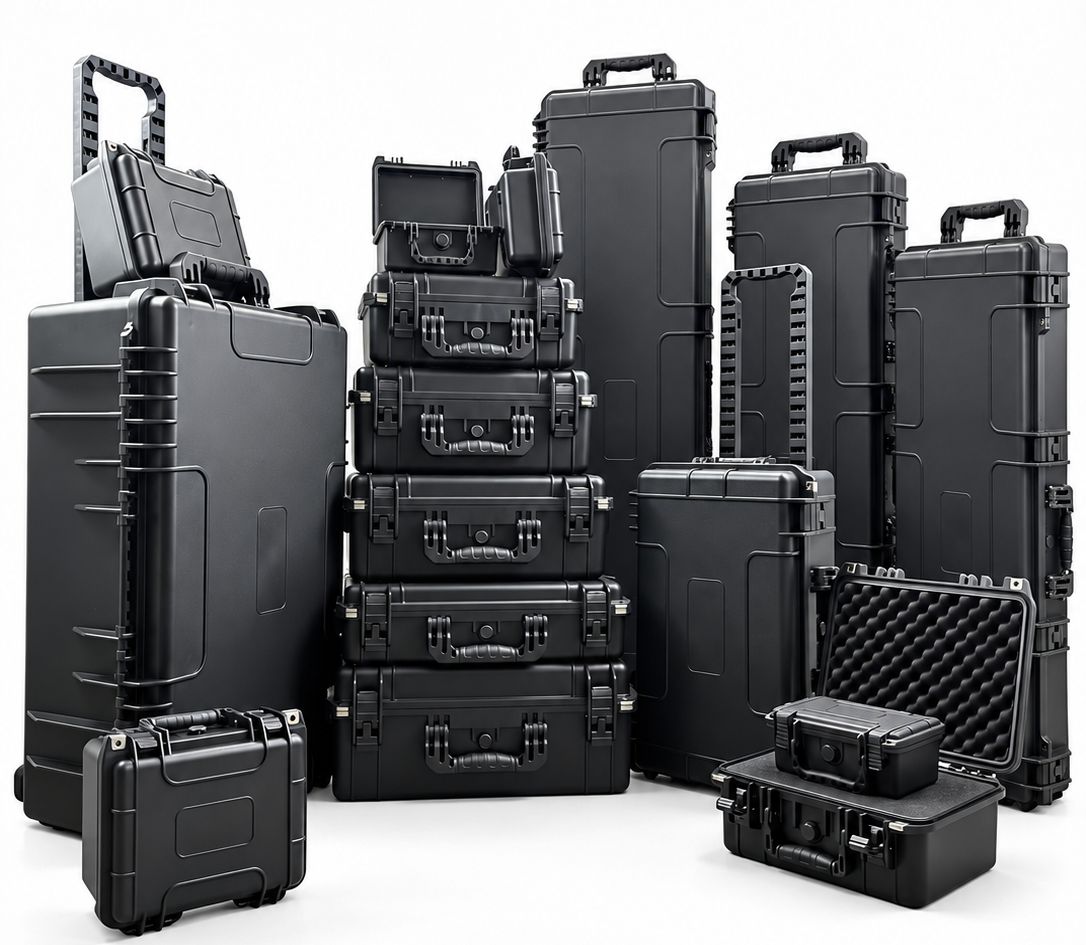
Plastics don’t fail gracefully when pushed outside their comfort zone—polycarbonate shatters under enough impact despite its reputation, while acrylic will craze after repeated contact with solvents that seem harmless. Start by ranking your actual exposure: is it a single sharp blow, continuous heat soak, or intermittent splashes of something aggressive? That order matters more than any single datasheet number.
For mechanical shock, polycarbonate and UHMW-PE sit on opposite ends of the spectrum—the former stiff and transparent, the latter almost waxy and self-lubricating. Heat changes the picture again: nylon and PEEK hold dimensions at temperatures where ABS turns soft, but they may not survive the same chemical bath. Run a small coupon test with your real fluid and temperature cycle before committing to a material spec.
Custom Interiors That Stop Tools and Components From Shifting
For anyone who's watched a socket set turn into a rattling mess after a short drive, custom-cut foam inserts are a quiet revolution. Instead of relying on generic dividers that leave wiggle room, these interiors trace the exact silhouette of each wrench, drill bit, or clamp. The result is a snug embrace that holds every piece still, whether the case is tipped on its side or jostled down a gravel road. It's the difference between opening your box to a tidy layout and opening it to a game of "find the 10mm."
But foam isn't the only trick. Modular rail systems and magnetic-backed panels let you rearrange storage as your kit evolves, gripping components firmly without forcing them into fixed molds. A set of calipers, a spare blade, even oddly shaped electronic modules—they all stay put because the interior adapts to their weight and size, not the other way around. No more cushioning gaps with shop rags or praying that friction alone will do the job.
The real payoff comes when you reach for a tool and it's exactly where you left it, not wedged under a heavier item or bouncing loose in a corner. Custom interiors turn a container from a simple box into a precision holder, cutting down on wear from metal-on-metal contact and making inventory checks a glance rather than a hunt. For professionals and hobbyists alike, that kind of quiet reliability is worth far more than the foam it's cut from.
From Field Kits to Lab Instruments: Tailored Protection in Action
A field kit tossed into the back of a truck shares almost nothing with a mass spectrometer bolted to a lab bench. One is expected to survive dust, drops, and sudden downpours; the other demands isolation from vibration, static, and even the oils on human skin. Tailored protection starts by ignoring the assumption that a single case or enclosure can serve both. Instead, every cutout, latch, and liner is chosen to match the specific fragility and operating context of the equipment it holds.
For field gear, that often means rotomolded shells with pressure-equalization valves, foam inserts sliced to grip irregular shapes, and quick-release straps that let a technician access a sensor without setting it on the ground. Lab instruments get a different treatment: machined aluminum frames that damp resonance, conductive liners that bleed away static before it reaches a detector, and gasketed panels that keep out airborne contaminants during a facility’s routine cleaning. The protection isn’t just about surviving a single event—it’s about preventing the slow accumulation of minor insults that degrade precision over months of use.
Consider a portable water-quality analyzer that travels from a wetland to a benchtop in the same week. Its field case must cushion it against rough handling on a boat and seal out humidity, but that same case can’t introduce particulates when opened in a clean testing area. A tailored solution might use a removable inner tray with a non-outgassing liner, allowing the instrument to move between environments without compromising either. That’s the difference between generic padding and protection designed around the actual journey the device will take.
The Design Process: From Measurements to a Working Prototype
Turning a set of measurements into something you can hold usually starts with a sketch, but the real work happens when those numbers meet physical constraints. I tend to block out the critical dimensions first—overall length, joint clearances, wall thickness—and then let a quick cardboard or foam mock-up reveal where the tape measure lied. It is surprising how often a 3 mm offset feels wrong in the hand, and adjusting that before touching CAD saves a full afternoon later.
From there, the prototype becomes a conversation between the digital model and the shop floor. I will print or cut a first version with deliberately loose tolerances, then mark interference points and flex zones directly on the part. One trick is to keep a set of calipers next to the prototype and write down the actual gap or thickness on the surface; these annotations turn the next iteration into a targeted fix rather than a fresh guess.
After two or three rounds, the prototype shifts from “does it fit” to “does it survive.” That means swapping in the real material, running it through the intended motion or load, and watching for the failure you did not design for. A working prototype is less about matching the drawing perfectly and more about carrying the load, moving without binding, and feeling right after a hundred cycles—measurements set the boundary, but iteration closes the gap.
How Custom Durability Reduces Replacement Costs Over Time
When equipment is built to withstand specific operational stresses, the usual pattern of frequent wear-and-tear replacements starts to fade. Instead of swapping out standardized parts every few months, businesses can rely on components designed around their actual load cycles, temperature swings, or abrasive conditions. That shift alone removes a surprising amount of hidden spending: rush orders, overnight shipping, and the labor hours tied to repeated tear-downs.
Over a longer horizon, the math becomes even clearer. A higher upfront investment in tailored materials or reinforced geometry often pays for itself once the first avoided replacement cycle is counted. Maintenance teams spend less time reacting to failures and more time on planned upkeep, which keeps ancillary parts from being damaged by sudden breakdowns. The result is a compounding effect: fewer replacements, lower labor demand, and less downtime all pull replacement costs downward year after year.
FAQ
ABS and polycarbonate are the usual go-to choices. ABS gives you good impact resistance at a reasonable cost, while polycarbonate can handle repeated drops and rough handling better if your budget allows. For lighter-duty applications, high-density polyethylene works well and resists chemicals.
Yes, the foam inserts are usually cut with water jet or CNC equipment based on your provided dimensions or a 3D scan. You pick the foam density and thickness, and the cutouts can follow every contour, even for items with protruding knobs or cables.
A good starting point is 3 mm for lightweight electronics and up to 6 mm or more for heavy gear that ships frequently. If the case will be stacked or transported by air, you'll also want to think about internal ribbing rather than just making the walls thicker, since that adds stiffness without much extra weight.
Many shops now handle single prototypes using routed or 3D printed shells, but the per-unit cost will be higher. For small runs under 50 pieces, you can keep tooling costs low by using standard extrusions or modular designs and then customizing only the foam and outer labels.
You can add a tongue-and-groove seal, a pressure relief valve, and an O-ring gasket around the lid. For full submersion, the case needs to be designed to IP67 or IP68 standards from the start, which affects the latch placement and hinge design too.
Plan on two to four weeks for a straightforward design using existing mold or sheet stock. If new tooling or complex die-cut foam is involved, expect six to eight weeks. Prototype approval and testing can extend that, so locking the design early is the biggest time saver.
Yes, you can choose from screen printing, digital UV printing, embossed logos, or laser engraving. The best method depends on the plastic surface and how durable the marking needs to be. For textured surfaces, digital printing often holds up better than screen printing.
Bring accurate dimensions or a CAD file of the item, the total weight, any drop or vibration requirements, the expected shipping method, and the annual quantity. Also note if there are temperature extremes or regulatory needs. The more detail you provide up front, the more accurate the first quote will be.
Conclusion
Off-the-shelf cases rarely survive real working conditions. Standard foam inserts leave equipment rattling against hard plastic, and a single drop can crack screens or misalign sensitive optics. That’s why choosing the right polymer matters as much as the latch. Polyethylene and polypropylene handle knocks without shattering, while polycarbonate stands up to heat and chemical splashes. A case built from the wrong material becomes just another disposable item. The interior matters equally: CNC-cut foam or molded trays hold each tool exactly where it belongs, so nothing shifts during transit. A wrench that migrates into a calibration unit turns a routine trip into an expensive repair.
Good case design starts with actual measurements, not guesswork. A manufacturer takes the equipment, documents every dimension and weak point, then builds a working prototype before any production run. This step catches clearance issues and handle placement problems early. It also explains why custom cases show up in field kits, lab instruments, and military electronics—different environments demand different seals, vents, and shock absorption. Over time, the math is simple: a case that prevents one broken sensor or a single damaged lens pays for itself. Replacement costs drop, downtime shrinks, and technicians stop improvising with duct tape and foam scraps. That’s the real measure of tailored durability.
Contact Us
Contact Person: Logious
Email: [email protected]
Tel/WhatsApp: +86 15867373883
Website: https://www.vso-case.com