

Custom Sand and Gravel Separator Chute Design Guide for Maximum Efficiency
2026-11-16
If your sand and gravel separator chute isn't designed for the way you actually run, you're leaving efficiency on the table. Custom chute design isn't just about angles and liners—it's about matching your material flow to your production goals. Sinou has been in the thick of these challenges, and this guide distills what actually moves the needle. Let's cut through the guesswork and get straight to what makes a chute perform at its peak.
Why Off-the-Shelf Chutes Underperform in Sand and Gravel Separation
Most off-the-shelf chutes are built around a one-size-fits-all approach: a generic steel box with a fixed slope and a standard liner package. Sand and gravel separation does not work that way. Wet sand sticks, angular gravel grinds, and mixed material changes speed depending on particle size and moisture. A stock chute often has square corners and abrupt transitions that create dead zones where fines accumulate and harden. That forces operators to hammer the chute or wash it out just to keep material flowing.
Impact and wear patterns are another weak point. Without a custom rock-box or replaceable wear ledges positioned at the actual trajectory of the incoming stream, off-the-shelf chutes concentrate abrasion on a small area. Holes appear within weeks, patching becomes a routine job, and liner replacement turns into a downtime sink. Meanwhile the uneven flow from a poorly matched chute can remix sorted fractions before they reach the next screen, quietly reducing the quality of the final product.
Calculating the Sweet Spot for Custom Chute Slope Angles
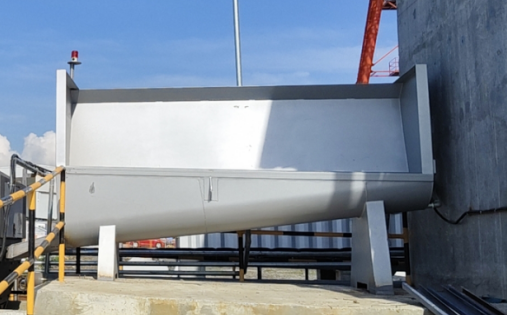
Finding the right chute slope isn’t about picking a number from a chart; it starts with the angle of repose for your specific material. Wet clay, dry sand, crushed rock, and even recycled asphalt all behave differently once they leave a conveyor. A slope too close to the material’s natural rilling angle will let fines build up on the chute floor, narrowing the flow path and eventually causing blockages. A slope that is too aggressive, on the other hand, accelerates particles beyond the target discharge velocity, increasing liner wear, dust generation, and noise. A practical starting point is to add 5 to 8 degrees to the measured angle of repose for the worst-case material condition you expect, then account for moisture and particle size distribution before locking in the geometry.
The real sweet spot is found by testing, not just by spreadsheet calculations. Build a short adjustable mock-up or use a section of pipe with a hinged base to observe how the material slides at different angles. Watch for the point where flow transitions from intermittent slumping to a steady, center-weighted stream without ricochet off the side walls. Keep in mind that a slightly steeper angle can help clear sticky residues, but every extra degree also adds to the impact force at the next transfer point. If you can run a trial with the actual tonnage and moisture levels, adjust the slope in 2-degree steps until you see stable flow with no visible carryback and acceptable liner wear over a full shift.
Liner Material Choices That Actually Survive Abrasive Sand
Polyurethane remains the safest default for most abrasive sand applications, but only if you pick the right durometer. Softer formulations in the 70–80 Shore A range absorb the cutting action of wet sand without splitting, while harder versions tend to chip once the sand dries out and turns glassy. Rubber liners still work for fine, rounded sand but lose ground fast against angular quartz or crushed rock.
Ceramic tiles earn their keep in dry, high-velocity zones where sand behaves like a sandblaster, though they demand a perfectly flat backing or they crack under point loads. Hardened steel plate can outlast everything in thick enough sections, but the added weight and cost rarely pay off unless you're dealing with continual impact from coarse, sharp particles. Most successful setups combine a tough, slightly flexible wear layer with a rigid support structure, and leave a small air gap behind the liner so it can flex without tearing at the mounting points.
Flow Control Tricks to Stop Clogging Before It Starts
Keep the fluid moving fast enough to stay turbulent, especially after bends or fittings where velocity drops and particles start to settle out. A short straight section just before a valve can quietly turn into a settling chamber if the flow rate is too low, so check those spots first.
Instead of running a steady stream, try pulsing the flow or briefly reversing it every few minutes. This breaks up the loose layer of material that forms along the pipe wall before it hardens or binds together. It costs almost nothing and works especially well for slurries, sticky fluids, and anything with fine solids.
Watch the pressure drop across the system rather than waiting for a full blockage. A slow rise in upstream pressure usually means something is building up. If you catch that early, a quick flush or a short increase in flow rate can clear the trouble spot while it is still soft, long before it becomes a hard clog.
Adjustable Baffle Designs for Switching Between Sand and Gravel
Adjustable baffle designs provide a straightforward means of altering material flow without swapping out major components. The baffle pivots on a central hinge, allowing operators to redirect the discharge stream from a sand collection area to a gravel chute by simply rotating a lever or turning a hand wheel. This eliminates the need to shut down the line and reconfigure chutes or screens, which is especially useful in operations where product blends shift frequently throughout the day.
Most adjustable baffles feature a reinforced steel plate with a curved leading edge to minimize material hang-up and reduce wear. The pivot mechanism often includes indexed locking positions, so the baffle stays firmly in place under heavy load without drifting. Some designs integrate a remote actuator or pneumatic cylinder, letting one worker adjust the baffle from a control station rather than climbing onto the equipment. Grease fittings at the pivot points extend service intervals and keep operation smooth even in dusty environments.
By incorporating an adjustable baffle, operators gain the ability to fine-tune the split between sand and gravel fractions on the fly. This reduces cross-contamination between product piles and helps meet tight specification tolerances without constant equipment tear-down. The design also extends the useful life of downstream conveyors and screens by directing abrasive materials away from sensitive components when switching from sand to gravel.
Designing Access Panels for Quick Liner Swaps Without Downtime
Access panels meant for liner changes should never require a full line stop. Hinged doors with quarter-turn cam latches work well here because they open fast and stay attached, so the liner can slide out without hunting for loose fasteners or needing a second pair of hands. Pre-compressed closed-cell gaskets around the opening stay in place during repeated swaps, which keeps dust and moisture from sneaking in while the panel is closed. Alignment pins or tapered slots help the panel seat evenly every time, preventing the warping that often comes from rushed reinstallation.
Another approach is a slide-out panel that rides on low-friction rails, letting a single worker pull the liner cassette forward and replace it in under a minute. Add a simple mechanical stop or latch sensor that reads panel position, and you avoid the temptation to leave the door ajar during production. For high-cycle areas, choose stainless steel hinges and glass-reinforced nylon latch bodies that resist galling and stay smooth after thousands of open-close cycles. These small hardware choices make the difference between a panel that invites regular liner swaps and one that gets ignored until something fails.
FAQ
A moderate slope between 35 and 45 degrees usually keeps material moving without causing fines to bounce over the screen. For wet or sticky loads, you might drop closer to 30 degrees and add a short vibration zone.
Wider chutes spread the feed across more screen area, so you can push higher volumes before blinding occurs. But if the chute gets too wide without matching flow control, gravel tends to rush the center and leave fines trapped at the edges.
AR400 steel plates handle abrasive gravel well for the main body, while replaceable polyurethane or ceramic liners make sense in high-impact zones. Using a combination cuts downtime more than a single hard-facing material.
Adjustable baffles are worth the extra cost if your feed source varies by season or pit location. Fixed divisions work fine for steady, well-graded material but often create bottlenecks once moisture or clay content changes.
A controlled water spray can break surface tension and wash fines through the screen faster, but too much water floods the separation zone and carries sand over with the gravel. Aim for a misting line rather than a heavy wash.
Use a slight forward tilt on the screen section plus a cleaning brush or rubber ball deck underneath. For stubborn near-size gravel, a periodic pulse of air from below works better than increasing the chute angle.
Compare the percentage of sand in the coarse oversize stream to the amount of gravel lost in the fine stockpile. If both are under 3 percent by weight on a dry sample, the separation is running near peak for most pits.
They match the actual grain size distribution, moisture level, and feed rate of your site instead of forcing your operation into a generic template. Custom length, transition, and screen opening choices remove the usual overflow or blinding problems.
Conclusion
Most stock chutes get the basics wrong for sand and gravel because they are built around generic material assumptions. Sand packs tight and wears surfaces differently than loose gravel, so a one-size-fits-all angle either backs up fine material or throws coarse stone too hard against the walls. The real efficiency gain comes from measuring your specific moisture content and particle size distribution, then setting the slope a few degrees steeper than the angle of repose for the worst-case wet sand. Liner choice matters just as much: plain mild steel erodes quickly, while ceramic or chromium carbide plates hold up far longer, though rubber liners can actually work better in high-impact zones where bouncing gravel causes less damage than abrasion.
Clogging is rarely a random problem; it usually starts at a transition or a slight flat spot, so adding a small water spray bar or a vibrating lip at those points keeps material moving without flooding the chute. Adjustable baffles let you redirect the stream for sand versus gravel without rebuilding the whole chute, and making them easy to reach from the outside means one worker can change settings between batches. If the liner is difficult to access, it will not get replaced on schedule, so access panels should be large enough to pull a full liner section out and positioned away from the main flow path. The payoff shows up as fewer shutdowns and consistent separation rates day after day.
Contact Us
Contact Person: HaiYan
Email: [email protected]
Tel/WhatsApp: +86 18957325588
Website: https://www.senyoubeton.com/