

High Speed HDPE Pipe Production Line Maximizing Output and Quality
2026-11-02
In HDPE pipe manufacturing, chasing higher line speeds often comes at the cost of wall thickness consistency and surface finish. That tension has forced many producers to settle for less than optimal output. But what if you didn't have to compromise? COMRISE high speed extrusion lines are engineered to break that trade-off, delivering both record throughput and rock-solid quality. Here's a closer look at the technology and process control that make it possible.
Screw Geometry That Pushes Output Without Overheating
Screw geometry often does more to control melt temperature than barrel settings alone. A well-designed screw moves material forward with less internal friction by adjusting channel depth, flight clearance, and compression ratio. For example, a deeper feed section paired with a gradual transition zone increases throughput per revolution without forcing the polymer through a sudden high-shear region. Barrier flights go a step further, separating the solid bed from the melt pool so that only a thin melt film contacts the barrel wall. This keeps heat transfer efficient and prevents the solid core from rubbing against the screw root, which is a common cause of localized overheating.
Mixing sections also play a big role when output needs to rise without raising melt temperature. Maddock or spiral mixers break up the remaining solid fragments at the end of the screw, but their geometry can be tuned to avoid excessive energy input. Tight flight clearances in the metering zone reduce backflow, so more material exits per screw turn with less wasted work. Some screw designs use variable pitch or wave profiles to continuously change the channel volume, which keeps the polymer moving and prevents dead spots where material can degrade. The net effect is a screw that runs faster and delivers more output while keeping the melt temperature closer to the barrel set point.
Cooling Tanks That Keep Pipe Round at High Line Speeds
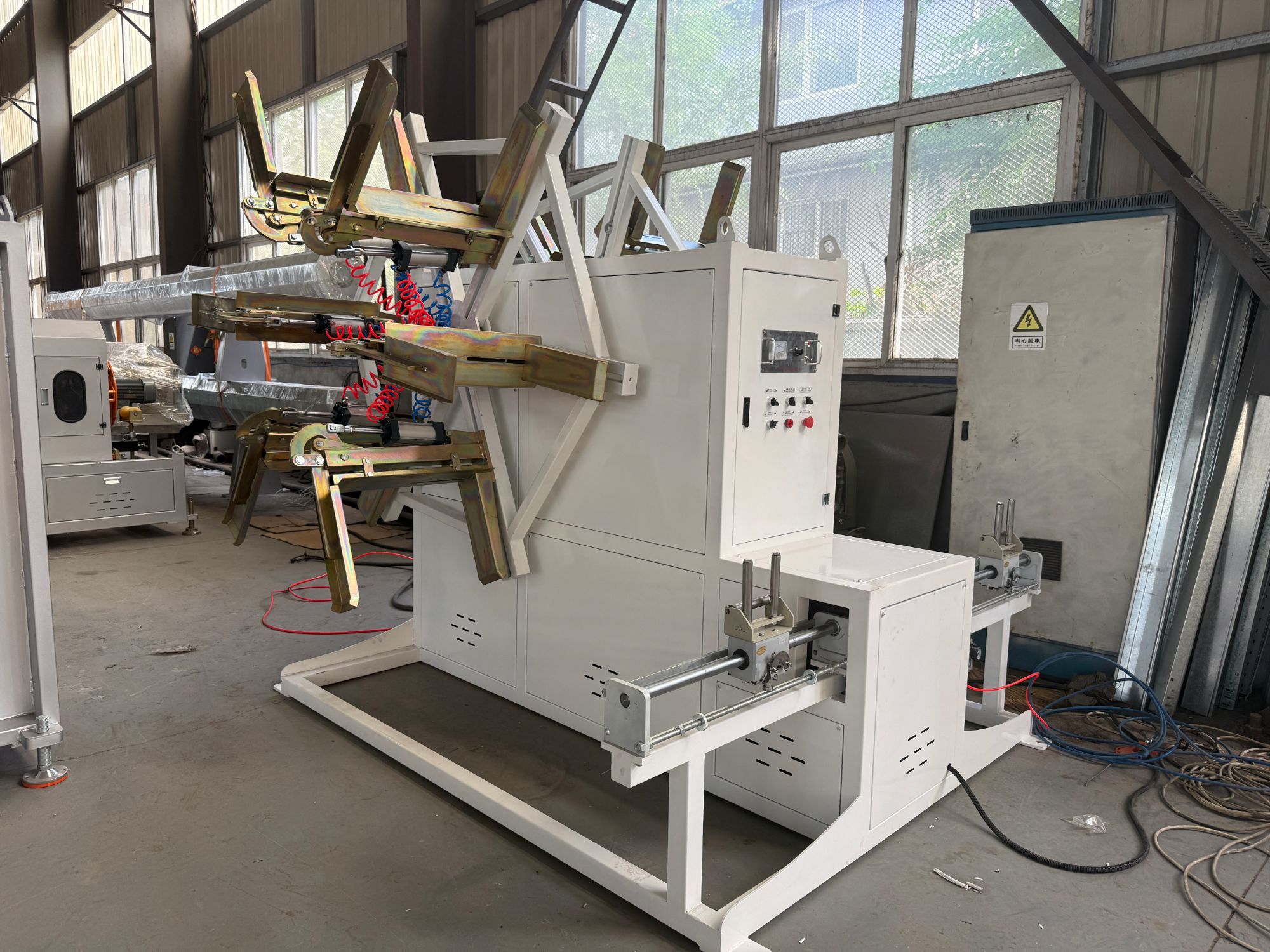
At high line speeds, the pipe emerges from the die with a thin, still-soft wall that can sag or flatten under its own weight before the plastic fully sets. A well-designed cooling tank holds the pipe in a controlled water bath while applying gentle vacuum or precise sizing plates. This keeps the outer diameter locked in a true circle as the material shrinks and stiffens, preventing the ovality that often shows up when lines run faster than the cooling system can manage.
The real trick is balancing water temperature, flow direction, and contact time. Water that is too cold can chill the surface too quickly and create internal stress, while uneven flow creates hot spots that let one side of the pipe drift out of round. Modern tanks use adjustable spray bars, baffles, and sometimes a slight vacuum to pull the pipe against calibration rings. As a result, pipe producers can push line speeds higher without watching roundness specs slip.
The Puller-Cutter Sync That Prevents Wobble and Waste
In high-speed converting lines, even a few milliseconds of lag between the puller and cutter can turn a clean cut into a ragged tear. That tiny mismatch shows up as edge wobble, inconsistent sheet lengths, and piles of scrap that never make it past quality control. The fix isn't a faster motor or a sharper blade—it's precise synchronization. When the puller's velocity profile is tuned to hand off material at exactly the right moment, the cutter sees a stable web, not a vibrating one.
The usual culprit is a control loop that reacts too late. Traditional setups let the puller run at a fixed speed while the cutter tries to chase it, leading to hunting and overshoot. A better approach uses feed-forward control: the cutter's position is predicted from the puller's encoder, not measured after the fact. This way, the blade arrives just as the material stops moving, so there's no tug, no double-cut, and almost no offcut waste.
On the floor, the difference is easy to spot. Operators stop seeing wavy edges on film or paper stacks that lean to one side. And when you check the scrap bin at the end of a shift, it's nearly empty. That's not luck—it's what happens when the puller and cutter finally move like one machine instead of two that happen to share a frame.
In-Line Ultrasonic Gauging for Zero-Defect Walls
Ultrasonic sensors mounted directly on the production line read wall thickness in real time, catching drift before it becomes scrap. The system doesn't wait for a lab sample or a post-cure inspection; it pushes a correction signal to the extruder the moment a thin spot appears. That shift from periodic sampling to continuous feedback is what makes a zero-defect target practical rather than aspirational.
For multi-layer walls, the gauging logic compares each layer's acoustic signature against a reference model stored from the first good article. If the inner layer lags by half a millimetre while the outer remains stable, operators see exactly which screw speed or temperature zone needs adjustment. No guesswork, no time lost pulling trial sections off the line.
When every wall is measured in motion, the definition of quality changes. Instead of accepting a statistical allowance for rejects, the line runs to a tighter band because deviations are corrected within seconds. The gauging data also builds a traceable record for each length produced, which matters when a customer asks why one batch behaved differently in the field.
Quick Size Changeovers Without Losing Production Tempo
On high-speed packaging lines, a size changeover usually means dropped bottles, misfed labels, and a line crawling back to full speed. The better approach is to treat changeover as a pit stop rather than a rebuild. Pre-set digital recipes, quick-release guide rails, and tool-less clamps let operators swap out format parts in under three minutes while the conveyor keeps its cadence. The trick is making every adjustment repeatable—no trial-and-error dialing after the restart.
Some plants keep the tempo by staging the next size’s change parts on a cart next to the line, with color-matched handles and numbered positions. Others use a short accumulation buffer so downstream machines never starve while upstream tooling is swapped. Even a 90-second overlap can hide the transition entirely. What matters is that the line never stops waiting for a wrench or a missing part.
The payoff isn't just saved minutes. When changeovers are quick and predictable, you can slot in smaller runs without wrecking the day’s output. Production planners stop batching big sizes to avoid changeover pain, and the floor starts trusting the schedule again. That’s how a plant keeps its rhythm while selling more variety.
Self-Regulating Melt Pumps for Constant Extrusion Pressure
In high-precision extrusion lines, pressure fluctuations at the die are the hidden enemy of dimensional consistency. Self-regulating melt pumps attack this problem at its source by continuously comparing the actual pressure signal from a transducer mounted just before the die against a setpoint. Rather than relying on a separate PLC loop or external corrections, the pump's internal control logic adjusts the gear speed in real time. This closed-loop response happens within milliseconds, keeping the melt pressure steady even when upstream conditions drift—whether from screw wear, pellet feed variations, or temperature shifts in the barrel. Operators no longer chase manual tweaks; the pump quietly holds the line within a fraction of a bar.
What sets these pumps apart from conventional gear pumps with fixed speed settings is their ability to absorb disturbances without sacrificing throughput. A typical setup might see a 1% step change in inlet pressure; the self-regulating unit counters by modulating the motor frequency just enough to restore equilibrium at the outlet. The result is a flat pressure profile that translates directly into tighter wall thickness tolerances, reduced scrap from thickness bands, and more stable bubble formation in blown film. For processors running recycled resins or masterbatch-heavy compounds, this adaptive behavior becomes a lifeline—the pump compensates for viscosity swings that would otherwise ripple through the die and ruin product quality.
Installation does not demand a complete line overhaul. Most self-regulating melt pumps integrate seamlessly with existing extruder control systems via a simple 4-20 mA signal or fieldbus interface. The pump's own controller handles the high-frequency pressure loop, leaving the extruder's main drive free to focus on melt temperature and throughput. Maintenance staff appreciate the clear diagnostics: rather than deciphering a tangle of external wiring, they see a single status indicator that tells them whether the pump is in auto-regulation mode, manual override, or alarm state. This design approach reduces commissioning time and eliminates the finger-pointing that often occurs when pressure issues arise between a gear pump vendor and an extruder OEM.
FAQ
At speeds above 30 m/min, a single-stage screw often struggles to deliver melt homogeneity, causing surging and inconsistent wall thickness. Using a barrier screw with a dedicated mixing section keeps the melt temperature profile tighter and lets the extruder run at higher rpm without over-sheating the polymer. This directly translates to fewer thickness deviations and less scrap.
Vacuum calibration is not just about pulling the pipe against the sizing sleeve. At high speed, residual melt memory can cause ovality if the vacuum is uneven or the water film breaks. Keeping the vacuum level steady and the spray nozzles clean ensures the pipe locks into shape within the first meter, so you get consistent outside diameter without adding excessive drag.
Melt flow rate alone won't tell you enough. Look for a bimodal HDPE resin with a narrow molecular weight distribution and a high melt strength. That combination drops less in viscosity at high shear rates, so the parison stays stable in the vacuum tank and you avoid sagging before solidification.
The biggest hidden energy drain is usually the cooling water loop. Using a closed-loop chiller with variable-speed pumps and setting the water temperature a few degrees above the dew point avoids condensation while still extracting heat fast enough. Also, switching from air-cooled to water-cooled barrel zones on the extruder lets you recover heat for pre-drying raw material.
An ultrasonic wall thickness gauge mounted right after the vacuum tank is the most valuable. It catches eccentricity trends immediately, so operators can adjust the die centering before a full coil goes out of spec. Pair that with a diameter laser gauge and you can detect slow drift in melt pressure that often precedes a gel or unmelt issue.
Start-up breakouts usually come from the die head not being fully thermally soaked. If the lip temperature is 10-15°C below the melt temperature, the outer skin freezes too early and tears when line speed ramps up. Soaking the die for at least 30 minutes under full temperature control and starting at 60% line speed before ramping avoids most of those tears.
Beyond daily checks on water filters and vacuum pump seals, the most overlooked item is the sizing sleeve wear. At high line speeds, even minor scoring on the sleeve surface creates scratches that grow into stress risers. Replacing or re-honing sleeves every 500-800 hours, depending on the filler content, prevents sudden diameter changes mid-run.
For HDPE, a grooved-feed section gives more positive conveying and higher throughput per screw revolution, which helps at high speeds. But it also raises melt temperature more. If your line uses a high percentage of recycled material or calcium carbonate filler, a smooth-bore with a longer compression zone may actually be gentler and easier to keep stable, even if peak output is slightly lower.
Conclusion
A genuinely fast HDPE pipe line earns its speed only by keeping every subsystem from drifting into its own failure mode. The screw is profiled to push more material through the barrel without letting frictional heat spike and degrade the melt, and that effort is backed by a self-regulating melt pump that flattens pressure swings so the die never sees a surge. Cooling tanks then step in with staged water temperatures and vacuum calibration that pull heat out evenly, holding the pipe round at speeds where lesser lines let the bottom sag into an oval.
Downstream, the puller and cutter are locked into a single motion profile, so there is no sudden grab or release to start a wobble or leave ragged end cuts. In-line ultrasonic gauging scans the wall continuously around the full circumference, flagging thin areas the moment they form instead of after a full coil is produced. Size changeovers run on preset recipes and quick-release tooling, dropping the time between diameters without a long drop in line speed. The combined effect is a production line that raises output and tightens quality in the same pass. That is how the line keeps both output and wall quality moving upward at once.
Contact Us
Contact Person: LISA LEE
Email: [email protected]
Tel/WhatsApp: +86 13780696467
Website: https://www.qdpipemachine.com