

OEM Sliding DU Bushing Selection Guide for Industrial Machinery
2026-10-31
When a single DU bushing fails inside an industrial press, the ripple effect can shut down an entire production line. Yet most maintenance teams still pick bushings by habit, not by load, speed, or environment. That’s where this OEM sliding DU bushing selection guide changes the game. Instead of sifting through catalogs and guessing, you’ll get a straightforward method to match the right bushing to your machine’s real working conditions. And if you need a supplier that takes the guesswork out of sourcing, XIAYI has the engineering support and inventory depth to keep your operations moving. Read on to stop bushing failures before they stop you.
Matching DU Bushings to Real Load and Speed Demands
Selecting a DU bushing based only on catalog ratings often leads to premature wear once actual operating conditions deviate from idealized test benches. The load a bushing truly sees is rarely constant; it fluctuates with vibration, misalignment, and start-stop cycles. Instead of relying on a single maximum static load figure, gather histograms of radial force over time. Then compare the cumulative load profile against the bushing's pv curve at the lowest expected shaft speed. For high-cycle applications, even brief spikes above the recommended pv limit can initiate localized overheating and polymer transfer to the shaft.
Speed introduces a second, often overlooked variable: heat dissipation. A DU bushing running at 200 rpm under 10 MPa may survive for thousands of hours, while the same bushing at 1200 rpm under identical load can fail in days if the housing does not sink heat away quickly. Check the actual surface speed of the shaft, not just motor rpm. Also consider intermittent duty cycles. A bushing that runs 20 seconds on, 40 seconds off, allows the PTFE-lead layer to cool and re-establish a transfer film, effectively raising its real-world speed limit compared to continuous rotation.
Field validation beats spreadsheet predictions. Run a short pilot batch with embedded thermocouples near the bushing back, or use temperature-indicating paint on the shaft. If the interface stays below 80°C under peak combined load and speed, the DU selection is safe. If not, reduce the projected area by changing bushing length, or move to a thinner wall to improve heat transfer. Matching a bushing to real demands means treating load and speed as a single thermal package, not two separate ratings.
Material Pairings That Prevent Galling in Harsh Environments
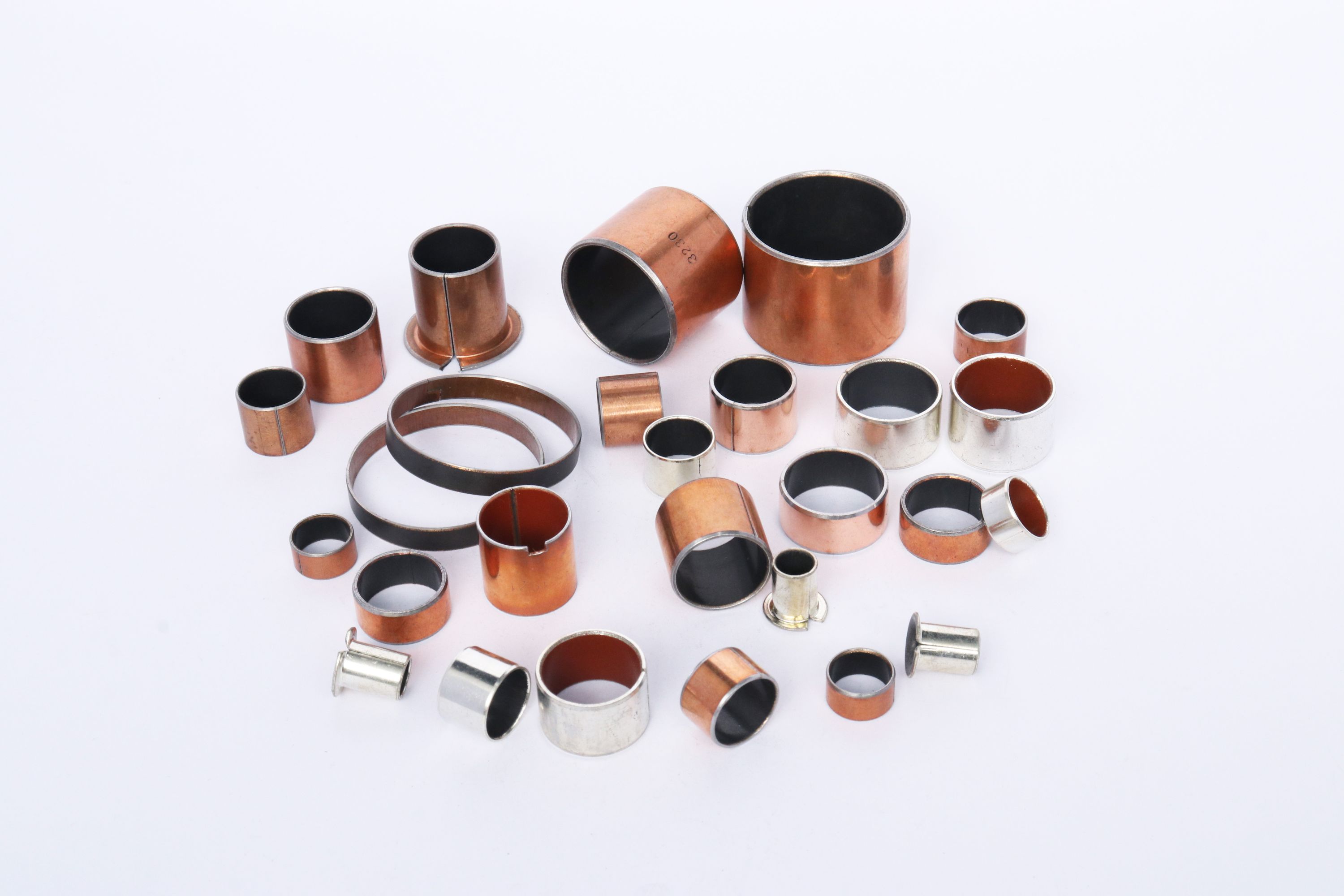
Galling is rarely just a materials problem; it's a systems problem that gets worse when you add corrosion, temperature swings, or loss of lubrication. Many engineers learn the hard way that pairing two stainless steel components under high contact stress in a salt-spray environment almost guarantees seizure, even with anti-seize compounds. A better starting point is to separate the two surfaces by hardness, crystal structure, or both. For example, a martensitic stainless pin against an austenitic stainless bushing can survive conditions that would destroy an all-300-series pair.
Certain combinations have built a reputation in aggressive settings. Nitronic 60 running against itself or against 316 stainless is a classic because its high silicon content disrupts adhesive transfer while retaining corrosion resistance. In subsea or chemical processing, aluminum bronze against hardened 17-4 PH or duplex stainless resists galling and also shrugs off seawater and mild acids. For high-temperature, high-load joints, stellite or other cobalt-based hardfacings paired with Inconel 718 prevent metal-to-metal welding without relying on liquid lubricants that cook off.
Surface engineering can turn a borderline pairing into a reliable one. Plasma nitriding, tungsten carbide thermal spray, or thin DLC coatings change the contact mechanics so that galling never gets started. The trick is to match the coating to the environment: a DLC coating that works beautifully in dry nitrogen may delaminate in hot sulfuric acid, while a nitrided case on stainless can reduce corrosion resistance if not controlled. Testing under your actual load, temperature, and chemical exposure beats any catalog recommendation.
Installation Tolerances for Consistent Slide Performance
Getting consistent slide performance starts long before the first cycle. The mounting surfaces need to be checked for flatness and parallelism, and the rails must be aligned to within a few thousandths of an inch. Even small deviations here turn into uneven preload, higher friction, and early wear on the recirculating elements.
Specifying tight installation tolerances is not about chasing numbers on a drawing. It is about giving the carriage a clean, predictable path. If one rail sits slightly higher than the other, the load transfers unevenly through the ball or roller contacts, which shows up as vibration and reduced life. Checking height variation along the full stroke, and between rails, usually reveals the problem before assembly is finished.
Field experience suggests that controlling parallelism to within 0.02 mm over a meter, and flatness to under 0.01 mm, keeps most standard slides running quietly. Where temperature swings are large, leaving a little more clearance in the mounting bolts or using floating-side rail designs can prevent binding without sacrificing rigidity.
Lubrication-Free Design: What Actually Keeps DU Bushings Quiet
Most people assume a bushing gets loud when the grease breaks down, so the fix must involve adding more lubricant. DU bushings flip that logic. Instead of relying on an oil film that can be squeezed out under load or washed away by contamination, they embed a solid lubricant—PTFE—into a porous bronze matrix. Under the first few cycles of movement, a microscopic transfer film coats the mating shaft, creating a sliding interface that has almost no tendency to stick-slip. That stick-slip is the real source of squeaks and chatter, and it disappears once the shaft and bushing settle into a low-shear, self-renewing contact.
The quiet operation also comes from what isn't there. A greased bushing can trap abrasive particles, and each re-lube cycle can push that grit deeper into the wear zone, producing grinding noise. DU bushings run dry, so there is no sticky film to collect dust and no oil viscosity change at low temperatures to cause morning groans. The bronze interlayer pulls heat away from the sliding surface fast enough to prevent localized hot spots, which means the PTFE film stays intact rather than breaking down into a rough, noisy surface. Over time, replenishment happens automatically as new PTFE is exposed from the bronze pores, so the noise suppression does not fade after a few hundred hours.
Surface Finish and Shaft Hardness Requirements Worth Checking
A smooth surface finish on a shaft isn't just about looks—it directly impacts seal life, friction, and even fatigue strength. Deep tool marks, scratches, or excessive roughness can chew through lip seals and create stress risers that lead to premature cracking. Before signing off on a shaft, run a profilometer across the bearing journals and seal contact areas. Target an Ra of 0.8 µm or better for dynamic sealing zones, and don't ignore the transition radii—those often get overlooked but see high cyclic stress.
Hardness is another spec that frequently gets bypassed until a shaft snaps or wears out in the field. For most rotating equipment, a surface hardness of 45–55 HRC on the journals provides a good balance between wear resistance and machinability. But don't just check the drawing—verify it on the actual part with a portable hardness tester. Case depth matters too, especially if the shaft has been induction hardened or carburized. A shallow case that ends right at the stress concentration can do more harm than good.
One practical trick is to test hardness at the fillet radius where the shaft steps down. That's where cracks usually start, and it's often the softest spot due to heat treatment limitations. If you find a hardness drop of more than 5 HRC from the spec, reject the part or ask for a re-heat treatment. Pair the hardness check with a visual inspection under a 10x loupe for grinding burns or micro-cracks—those defects won't show up on a standard hardness reading but will eventually cause a failure. Getting these two parameters right upfront saves hours of teardown and warranty headaches later.
Field Signs Your DU Bushing Is Undersized for the Job
You'll often catch an undersized DU bushing by the heat it throws. After a short run, the housing will feel hotter than a properly sized unit at the same duty cycle. The PTFE overlay breaks down quickly under excessive point loading, leaving a dull, smeared appearance rather than the normal dull grey. If you slide the shaft out, you may see bright bronze streaks where the overlay has been scrubbed away—this is a classic sign the bushing is being asked to carry more than its diameter or projected area can handle.
Another tell is the shaft fit itself. If the bushing ID is marginally too tight for the nominal shaft, you'll notice a tight spot during assembly, or the shaft will need a hard push or light tapping to seat. In operation, this translates to elevated startup torque, occasional stick-slip, and a low-frequency groan that disappears once speed picks up. Not every bushing squeals when undersized; sometimes the failure is quieter—just a gradual rise in running temperature and a polish mark on the shaft opposite the load zone.
Watch for unusual wear patterns at the edges of the contact area. An undersized DU bushing tends to wear in a narrow band rather than a broad, even footprint. You may also see edge loading because the bushing can't conform properly under load. Field maintenance logs often show repeated bushing swaps at the same position within a few hundred hours, even when lubrication looks fine. If you're replacing the same DU more often than expected and the shaft measures within tolerance, it's worth double-checking the load rating and projected area before blaming the part quality.
FAQ
DU is a widely used industry designation for a composite plain bearing that has a steel backing, a porous bronze sintered layer, and a PTFE-based overlay. The name comes from an old bearing material code but has turned into a generic term for this style of self-lubricating bushing.
Start by matching the shaft diameter to the bushing inner diameter after installation, then check the housing bore and available wall thickness. Pay attention to press-fit allowance and the running clearance you actually get after the bushing is installed, because the ID often shrinks slightly when pressed into place.
Most standard DU bushings are rated for static loads around 140 N/mm² and dynamic loads in a similar range depending on speed and temperature. Always verify with the specific manufacturer's data sheet since material grades and backing thickness can change the numbers.
They are designed to run dry, so continuous lubrication is not required. A small amount of grease or oil can be used during assembly to help with fitting, but adding lubricant in service can attract dust and abrasive particles, which shortens life.
A hardened steel shaft with a surface hardness above 50 HRC and a roughness between 0.2 and 0.4 µm Ra gives the best results. Softer shafts tend to wear faster and can damage the PTFE transfer film that provides the low friction.
They handle mild contamination reasonably well because the PTFE overlay can embed small particles, but heavy abrasive dirt or water with grit will reduce service life. In those conditions, adding seals or moving to a thicker-walled bearing often helps.
Use a stepped tool or an arbor press that applies force only to the bushing face, never the flange. Make sure the housing bore is clean and chamfered, and always check the inner diameter after pressing because the ID can shrink enough to affect shaft fit.
Yes, they are often one of the best options for low-speed, high-load oscillating or sliding movements. The PTFE overlay forms a transfer film on the shaft, which keeps friction low without needing an external oil supply.
Conclusion
Selecting the right DU bushing for an OEM slide starts well before the first prototype run. Instead of defaulting to a catalog number, match the bushing to actual load and speed conditions—continuous sliding under moderate to high radial loads demands a different margin than intermittent, low-cycle motion. Pairing the backing steel, porous bronze layer, and PTFE-lead lining with a properly hardened and finished shaft is what prevents galling when dust, washdown fluids, or uneven alignment show up in the field. Keep shaft hardness at or above HRC 50 and surface finish in the 0.2–0.4 µm Ra range; anything rougher shortens film transfer, anything much smoother can starve the interface.
Installation tolerances are where most slide performance is won or lost. A housing bore that pinches the bushing even slightly closes the designed running clearance, drives up noise, and makes the slide feel sticky under light loads. Press the bushing into an H7 bore, then size the running fit to the application—not the other way around. In lubrication-free designs, quiet operation comes from proper alignment and stable PTFE transfer, not from added grease. Field signs of an undersized bushing usually appear as polished shafts, edge loading, squeal at stroke reversal, or localized heat after short cycles. Reading those signs early prevents a slide rebuild and points directly to the next size up or a longer bushing to restore even wear.
Contact Us
Contact Person: Leela
Email: [email protected]
Tel/WhatsApp: 8613586885132
Website: https://www.xiayishockparts.com