

Top Sewer Cleaning Equipment Factories Powering Modern Drainage Solutions
2026-11-16
Beneath every modern city lies a hidden network of drains and sewers that rarely gets attention—until something goes wrong. Keeping these systems flowing isn't just about reactive fixes; it relies on cutting-edge equipment built by manufacturers who understand the gritty demands of the job. Among the names reshaping the industry, AMJET stands out for its innovative approach to high-pressure jetting and vacuum solutions. In this article, we’ll explore the top sewer cleaning equipment factories that are truly powering today’s drainage solutions, and why their machines are becoming essential for municipalities and contractors worldwide.
Inside Labs Where High-Pressure Jetting Hits New Benchmarks
Walk through the doors of these research facilities and the first thing you notice is the quiet hum of pumps capable of pushing water past 90,000 psi. It isn't brute force alone that sets new records here—it's the obsession with controlling a jet thinner than a human hair. Engineers adjust nozzle geometries, abrasive mixes, and standoff distances in real time, watching through reinforced glass as a thin stream peels away layers of titanium or composites without transferring heat or stress to the material beneath. Every parameter logged, every deviation analyzed, the goal is repeatable precision that borders on the microscopic.
One corner of the lab is dedicated to pulsation sequencing, where jets are modulated hundreds of times per second to create a hammering effect that chews through hard rock or thick steel without wasting water. Elsewhere, sensors embedded in cutting heads feed data into machine learning models that predict wear and automatically compensate for nozzle erosion mid-operation. A visit reveals that the real breakthroughs happen not in the jet itself, but in the milliseconds between pressure waves—timing the impact so that material fractures along intended paths before the fluid even accumulates. It is a blend of fluid dynamics, materials science, and code that feels more like surgery than industrial cutting.
Beyond pure performance, the teams here are chasing something harder to measure: reliability at the limits. High-pressure seals that survive thousands of cycles, swivels that maintain a perfect stream while rotating at 200 RPM, and filtration systems that keep the water cleaner than drinking water are all part of the invisible infrastructure. When a new benchmark is announced—a depth of cut in Inconel, a speed through reinforced concrete—it reflects months of quiet iteration on these unsung components. The labs don’t just push the pressure gauge higher; they redefine how long a system can hold that pressure without flinching, turning peak numbers into practical tools.
Factory Floors That Turn Raw Steel into Debris-Devouring Workhorses
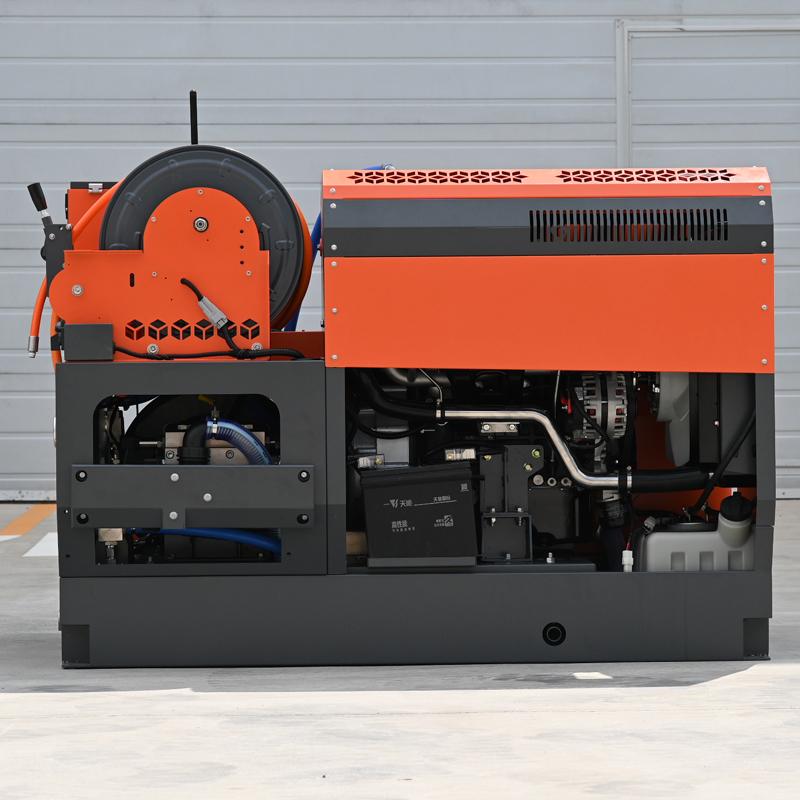
Steel arrives as silent, heavy coils—gray and inert as a winter sky. But step onto these factory floors and the transformation is immediate. Lasers slice through plate with a hiss, hydraulic presses shape chassis frames in single, violent claps, and robotic arms weld seams with a shower of sparks that smell of ozone and hot iron. Each machine seems to understand its own hunger: some chew through sheared edges, others swallow entire lengths of bar stock, and all of it happens under a rhythm that’s less orchestrated and more instinctive. The air hums with the constant vibration of conveyors and cooling fans, while overhead cranes glide like patient predators, lowering raw steel into the jaws of machines that will never be full.
The machines themselves are designed to feed without pause. They don’t tire, they don’t question the hardness of the alloy or the thickness of the sheet—they just consume. Feed mechanisms adjust automatically to changes in material, sensors detecting width and weight in milliseconds, rerouting pieces through the line before a human even notices a jam. It’s a strange kind of symbiosis: the steel is cold and unyielding, but once inside the belly of a stamping press or a CNC mill, it emerges as a shaped component, still warm to the touch. The detritus—the shavings, the offcuts, the scraps—falls away like discarded skin, collected in bins that themselves get carted off to be melted down again. Nothing is wasted, only repurposed, as if the floor itself has learned the language of perpetual digestion.
Yet for all the noise and raw force, there’s a kind of grace in these debris-devouring workhorses. A decades-old drop hammer, its frame scarred by a million impacts, still hits with a precision that feels almost delicate. Newer multi-axis turning centers hum at such high frequencies they seem to be singing. Maintenance crews know the personality of each unit: the press that prefers a certain grade of hydraulic oil, the laser cutter whose alignment drifts when humidity spikes. They are not just machines but longtime collaborators in an unending steel feast, turning inert stock into the skeletons of bridges, the frames of trucks, the guts of engines. Watching a beam line or a blanking line in full swallow is to understand that even the most brutal appetite can be tuned to near perfection.
Why Leading Manufacturers Are Swapping Standard Specs for Adaptive Hydro-Mechanics
For decades, hydraulic systems have been engineered around rigid performance curves—fixed pressure thresholds, predetermined flow rates, and static damping maps. That approach worked when machinery operated in predictable cycles, but today’s mixed-material fabrication lines, variable-temperature logistics centers, and multi-configuration heavy equipment demand something far more responsive. Leading manufacturers are walking away from the old catalog-spec mindset and embedding self-adjusting, sensor-driven hydro-mechanical loops that recalibrate in real time to load, viscosity, and wear conditions. The result is not just smoother operation; it’s a fundamental shift from designing for an average day to designing for whatever the next second brings.
The pivot isn’t theoretical. Adaptive hydro-mechanical systems are already outperforming conventional ones in applications where downtime isn’t an option. Instead of relying on oversized accumulators or conservative relief settings to handle pressure spikes, these systems use fast-acting proportional cartridges and machine-learning-based control boards that learn friction signatures and preemptively adjust valve overlap. A press line, for instance, might feel a slug of thicker material and, within milliseconds, soften its deceleration curve while boosting pilot pressure just enough to avoid cavitation. No manual tuning, no scheduled recalibration—just continuous morphological change that keeps the machine inside its safe, efficient band regardless of what it’s processing.
What’s pushing this transition is a quiet convergence of commodity hardware and field-proven intelligence. Brushless servo-pumps paired with microfabricated pressure arrays now cost less than the downtime from a single blown seal in a high-throughput plant. When the hydro-mechanical backbone of a factory stops being a fixed specification and becomes an adaptive system, maintenance intervals stretch, energy consumption drops by double-digit percentages, and engineers stop chasing phantom alarms that turn out to be nothing more than the machine trying to tell them the blend of fluid changed by five percent. It’s not a feature upgrade; it’s a different philosophy of how fluid power should behave.
Quiet Revolutions in Trenchless Tech Born on the Assembly Line
Walk through any modern pipe rehabilitation facility and you might sense something unexpected: a hush. Gone are the days of roaring compressors and clanking steel. Instead, automated assembly lines now stitch together advanced resin-impregnated liners with surgical precision and barely a murmur. This shift toward quieter manufacturing isn’t just about comfort; it reflects a deeper engineering philosophy where tighter tolerances, cleanroom protocols, and robotic arms replace brute force. The result? Trenchless solutions that arrive on site pre-calibrated and nearly ready to deploy, drastically reducing street-level noise and disruption.
The real breakthrough happens where material science meets modular production. UV-cured liners, once a batch process reliant on manual mixing, are now rolled off in continuous lengths under tightly controlled conditions. Quality control sensors embedded along the line capture micro-variations in wall thickness and cure potential, discarding flawed sections without human intervention. This isn’t the assembly line of the last century—it’s a data-driven ecosystem that refines itself loop after loop, spawning pipe repair products that are lighter, stronger, and far less prone to field failures.
Contractors have started to notice the domino effect. With factory precision replacing on-the-fly adjustments, crew sizes shrink, rework plummets, and project timelines compress. What began as a supply-chain taboo—bringing mass production techniques into an industry that prides itself on bespoke fieldwork—is now quietly reshaping what’s possible underground. The hum of progress isn’t louder. It’s just more consistent.
How Real-World Field Feedback Shapes the Next Generation of Extractors
Every dusty sensor, every jammed auger, and every overheated motor in the field tells a story that no laboratory can fully replicate. We’ve learned that the most transformative improvements to our extraction equipment rarely sprout from design boards—they bloom from the notes of operators who wrestle with inconsistent feedstocks at dawn and troubleshoot pressure drops under a midday sun. Their handwritten logs and hurried radio calls have become the raw material for our next generation of machines, pushing us to rethink vibration damping, sealing geometry, and even the way controls respond to sudden load shifts.
Rather than treating these reports as isolated complaints, we now thread them into a continuous feedback loop that directly informs hardware and software revisions. When a grower in a wet climate reported chronic clogging, it wasn’t just a service ticket—it triggered a complete redesign of the pre-filter assembly, with wider clearances and self-clearing channels that now ship as standard. Similarly, a processor running high-CBD hemp noticed subtle efficiency losses over time; tracking that data point back to a gradual buildup on a rarely inspected baffle led us to introduce real-time coating detection, now embedded in the firmware of our flagship model.
The result is a lineage of extractors that feel more like partners than appliances. The machines don’t just run—they listen, in a sense, adapting through every field-informed firmware update and every physical tweak forged from a real-world stress test. It’s a quiet evolution that happens far from the showroom floor, driven by the people who depend on these tools daily, and it’s why the next generation doesn’t feel like a leap so much as a perfectly natural step forward.
Material Science Upgrades That Make Corrosion Obsolete Underground
For decades, burying metal underground meant accepting a slow, inevitable decay. Moisture, shifting soil chemistry, and stray electrical currents turned pipelines, storage tanks, and foundation anchors into rust-weakened liabilities. The newest wave of material science doesn’t just slow this process—it rewrites the rules entirely, making corrosion a non-issue through breakthroughs that merge metallurgy, polymer chemistry, and surface engineering in ways that feel almost intuitive.
One standout shift is the rise of high-entropy alloys designed specifically for subterranean use. Instead of relying on a single dominant metal, these alloys blend five or more elements in near-equal proportions, forming a stable microstructure that resists the pitting and crevice attack common in clay-rich soils. Paired with bio-inspired coatings that mimic the self-healing properties of human skin, the new materials can seal micron-scale cracks as soon as they form, blocking the path for corrosive ions before any meaningful damage occurs.
Beyond the metal itself, the game changer lies in the interface between material and earth. Engineered composite wraps that fuse a dense outer layer with an inner layer of electrically active graphite now perform real-time cathodic protection without external power. Simultaneously, concrete reinforcements made from basalt fiber—stone melted and drawn into thread—carry greater tensile strength than steel yet remain completely inert in alkaline and acidic groundwater. Together, these advances flip the script: underground infrastructure no longer fights corrosion; it simply lives outside corrosion’s reach.
FAQ
It's rarely about a single machine. The best ones combine deep engineering know-how with a real understanding of field conditions—think continuous R&D, rigorous testing in buried Infrastructure, and a service network that doesn't leave you stranded. They don't just sell you a jetter; they treat corrosion resistance, nozzle design, and operator safety as obsessions, not afterthoughts.
Smart factories have moved beyond brute force. They're mastering water reclamation systems that filter and reuse flow right on the truck, so you're not just blasting gallons into the storm drain. Electric and hybrid units are becoming serious contenders, and the real craft lies in fine-tuning pressure and flow to strip away debris without damaging aging pipes—that's where the engineering artistry shows.
A pump might give you the muscle, but the nozzle is the brain. Leading workshops design proprietary nozzles with fluid dynamics in mind—ceramic inserts for longevity, angled jets that pull the hose instead of just pushing water. They're solving problems like fatbergs and root intrusion with vortex patterns that chew through solid masses, something off-the-shelf copies simply can't replicate.
Mass production works for clogged kitchen sinks, but when a city has century-old brick sewers or a chemical plant deals with caustic slurry, the cookie-cutter approach fails. The factories that lead the pack often have dedicated engineering cells that reconfigure trailer mounts, add explosion-proof ratings, or design retrieval winches for deep manholes. It's basically made-to-measure gear for underground hazards.
They're embedding intelligence into the equipment itself. We're seeing one-touch automated cycles that prevent rookies from blowing out pipe joints, and telematics that let a veteran supervisor guide a crew from miles away via real-time video and pressure data. Some even use augmented reality for troubleshooting, turning a steep learning curve into an interactive walkthrough.
Absolutely. Fatigue is a real danger when crews wrestle heavy, kinked hoses all day. The forward-thinking plants have introduced lightweight composite hoses with a 'memory' that resists coiling, and slow-retract reels that prevent whipping. There's a quiet revolution in couplings, too—quick-connect fittings that can be swapped without tools while wearing frozen, grimy gloves.
It's the little decisions made during fabrication: fully welded frames instead of bolt-together assemblies that loosen, powder coating that can take a chipping from gravel roads, and water tanks baffled to prevent surging that destabilizes the vehicle. The best factories treat the entire package like a single integrated system, not just a tank, engine, and pump thrown onto a chassis.
They design with modularity in mind. A jetter bought today can often be retrofitted with a newer control panel or a more efficient pump five years later, without scrapping the entire rig. This mindset extends to training—the top places constantly update digital manuals and offer subscription-based skill upgrades, so your team grows alongside the machine.
Conclusion
The most forward-thinking sewer cleaning equipment factories have torn up the old playbook, turning their R&D wings into high-pressure proving grounds where jetting nozzles are pushed until water itself seems to surrender. Inside these labs, engineers chase micron-level tolerances and novel nozzle geometries that carve through decades of grease and scale without flinching. But the real alchemy happens a few hundred yards away on the factory floor, where raw steel arrives as blank sheets and coils, then exits as truck-mounted monsters that devour wet wipes, roots and mineral buildup whole. The machinery here doesn't just weld and cut—it integrates adaptive hydro-mechanics right into the chassis, swapping fixed-orifice limitations for self-regulating pumps and intelligent valve trains that read the pipe's own backpressure and adjust in real time. This shift away from one-size-fits-all specs means a single unit can descale a 36-inch storm culvert in the morning and clear a cramped lateral line by afternoon without an operator ever touching a bypass valve.
Meanwhile, the assembly line itself has become a quiet incubator for trenchless innovation. Cured-in-place pipe packers, lateral reinstatement cutters and pull-back extractors are no longer afterthoughts; they're designed in parallel with the jetting units, sharing the same hydro-mechanical DNA. Field feedback now feeds directly into next-generation cable machines and vacuum extractors, with debris tank baffles reshaped after crews complained about carryover, and camera reel tension systems re-engineered because a single municipality reported cable snapback in freezing conditions. Underpinning it all is a relentless upgrade in material science: duplex stainless steel bodies, ceramic-coated pistons and nickel-alloy wear rings have made internal corrosion a relic of the past, even in hydrogen-sulfide-rich environments that used to eat equipment alive. These quiet material revolutions mean that machines emerging from these top factories don't just survive underground—they outlast the pipes they clean, redefining what modern drainage solutions can demand from the gear that powers them.
Contact Us
Contact Person: Mike
Email: [email protected]
Tel/WhatsApp: +86 19545555505
Website: https://www.amjeting.com/